Chapter I · Lantern Festival Encounter
Wang Zifu of Luodian lost his father early, yet by fourteen he had already passed the xiucai examinations. His mother treasured him and seldom allowed him beyond the village lanes. A marriage had once been arranged with a girl of the Xiao family, but she died before the wedding, leaving him single.
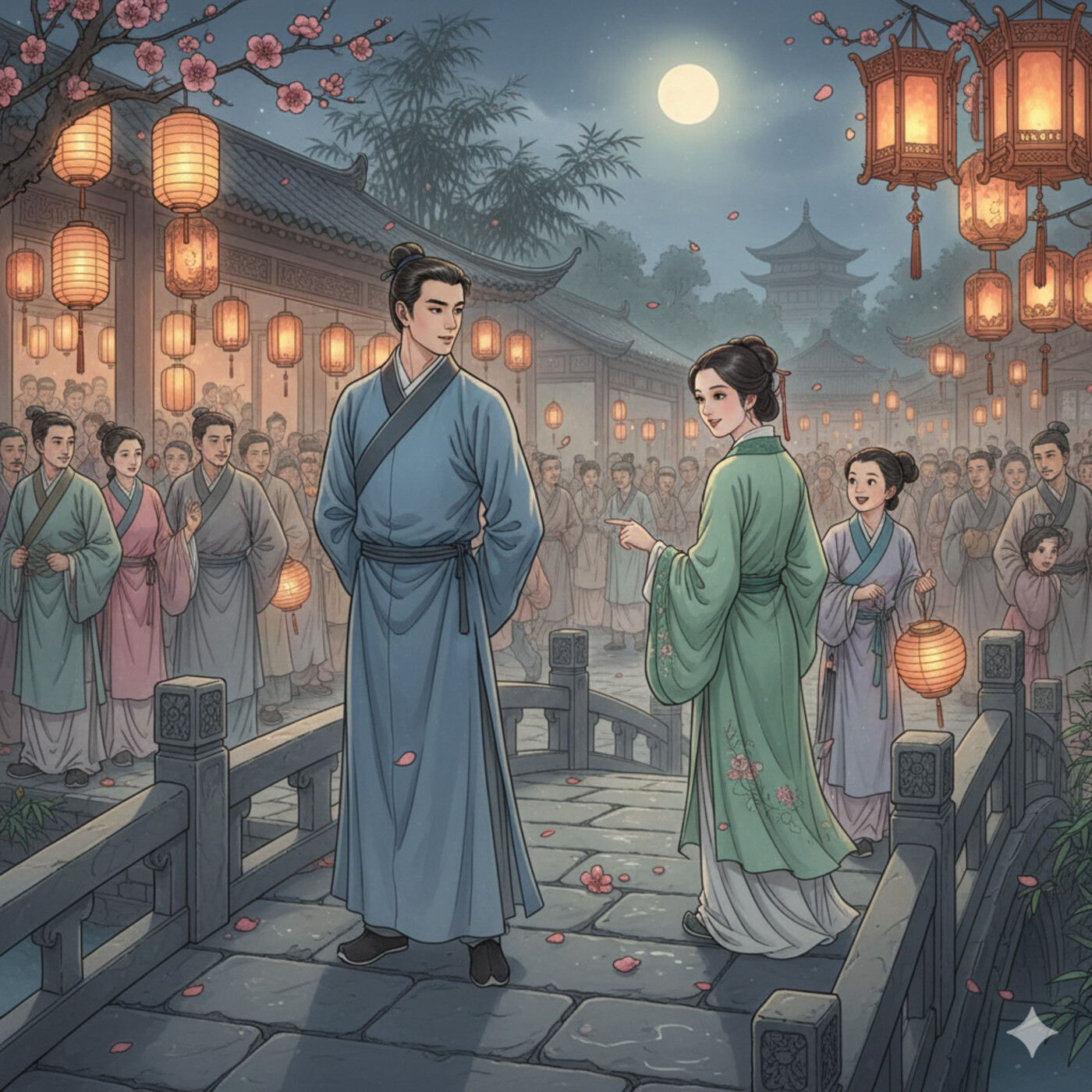
On the Lantern Festival, his cousin Wu invited him into town. Before they reached the outskirts, Wu was summoned home by a servant, leaving Wang to wander alone among a sea of revelers. He saw a young lady attended by a maid, twirling a sprig of plum blossom, beauty unrivaled and smile irresistible. Forgetting all propriety, Wang stared. The girl glanced back and told her maid, “That fellow’s eyes glitter like a thief’s,” tossed the blossom aside, and strolled off laughing.
Wang picked up the plum, carried it home, hid it beneath his pillow, and lay down without eating or speaking. His anxious mother summoned monks and Daoists to drive away evil influences, but his illness grew worse. Physicians bled and dosed him; he only drifted in and out of consciousness.
When cousin Wu visited, Wang burst into tears. Pressed for the truth, he confessed the encounter and begged Wu to find the girl. Wu laughed, promising it would be easy—surely a girl who walked the festival streets was no noble daughter, and if she already had a match they could simply outbid it. Wang’s spirits lifted. Wu relayed everything to Wang’s mother and began asking after the maiden, yet no trace could be found.
Days later Wu returned, falsely claiming success. “She is my aunt’s daughter—your maternal cousin—living thirty li southwest.” Wang rejoiced and entrusted Wu again, but Wu never returned. Irritated and heartsore, Wang clutched the now withered blossom and brooded. At last he resolved to go himself, stowing the flower in his sleeve and slipping out without a word to his family.
Chapter II · The Willow-Walled Household
Wang traveled alone through empty foothills for more than thirty li. Mountains stacked upon mountains, lush groves scented the air, and no trace of people appeared save for a narrow goat trail. At the end of a valley, amid flowering shrubs, a tiny settlement emerged.
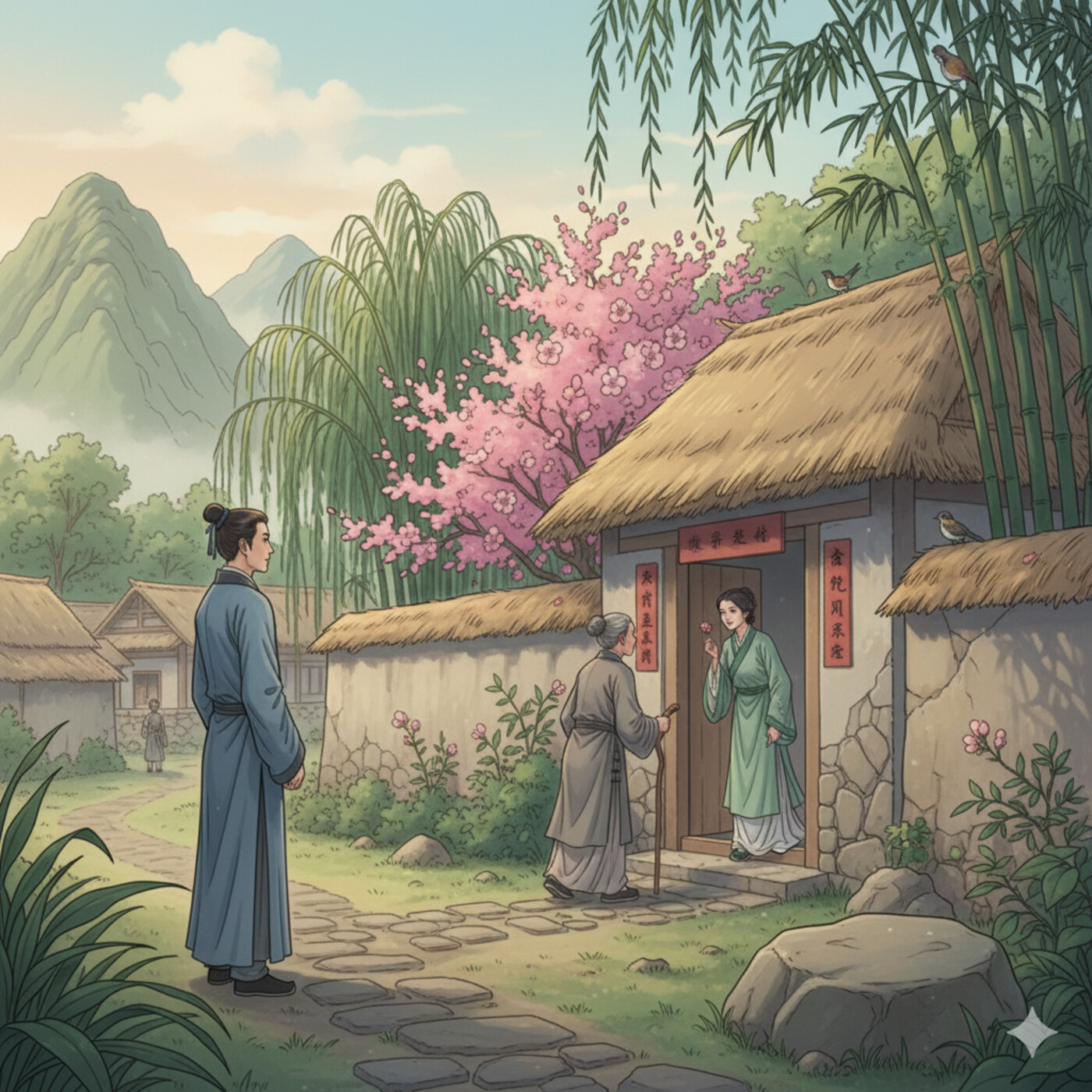
He descended to the village. The houses were few and thatched, yet their surroundings were elegant. One northern courtyard was lined with drooping willows; its walls sheltered peach and apricot trees and a clump of bamboo filled with bird song. Wang dared not intrude, so he sat upon a smooth stone opposite the gate.
From within he heard a woman call the maid Xiaorong in a lilting voice. Moments later the very girl from Lantern Night appeared, an apricot blossom poised between her fingers as she raised it toward her hair. Seeing Wang, she smiled and slipped back inside, blossom in hand.
Bewildered, Wang waited from dawn to dusk, hunger forgotten. At last an elderly woman with a cane emerged. “Young sir, you have been here since morning—are you waiting for someone? Are you hungry?” she asked. Wang bowed and murmured, “I have come seeking kin.”
The old woman, half deaf, made him repeat himself and pressed him for the relative’s surname. When he stammered, she laughed. “A scholar, surely! Come in, share a simple meal, rest the night. Tomorrow you may inquire again.”
She led him through a paving of white stone where red petals carpeted the steps, then along a path beneath bean trellises into a bright reception hall. The whitewashed walls gleamed like mirrors and crabapple boughs leaned through the lattice. As Wang sat, curious faces peeked in at the window.
“Xiaorong, prepare the meal,” the old woman called. While the maid bustled away, she asked about Wang’s family. Learning that his maternal clan was surnamed Wu, she clapped in surprise: she herself was Qin, his aunt, who had lost contact through years of poverty and childlessness. The girl in her care was a concubine-born orphan she had raised, clever but incorrigibly merry. “I will have her greet you shortly,” she said.
Soon the maid returned with tender chick and ample dishes. After Wang ate, the old woman bade the maid summon “Lady Ning.” Laughter tinkled outside before the girl entered, hand over mouth, still shaking with mirth. Thus began Wang’s entrance into the willow-walled household.
Chapter III · Laughter in the Garden
The maiden—whom the aunt called Yingning—could scarcely stop laughing long enough to greet him. When Wang asked her age, she bent double with mirth. “Sixteen,” the aunt answered for her, chiding that the girl still behaved like a child. The old woman even sighed that, were it not improper for cousins to wed, the pair would be perfectly matched.
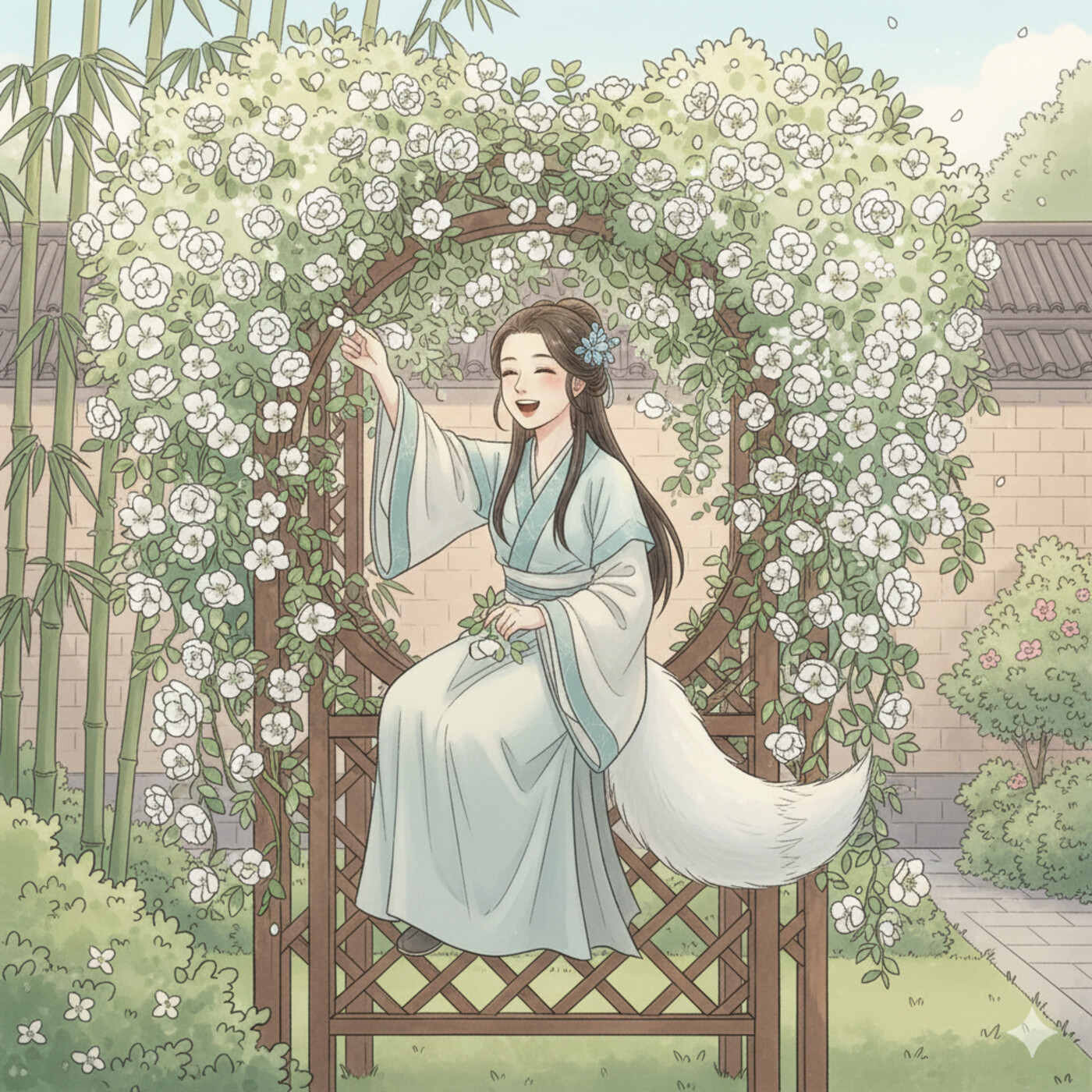
That night Wang remained as guest. The aunt suggested he stay several days, promising a small garden and books to occupy his time. At dawn he explored the rear courtyard and found half an acre of velvety grass, sheds encircled by blossoms, and downy catkins strewn across the paths.
Suddenly branches rustled overhead. Yingning perched in a tree, laughing so hard she nearly fell. Wang begged her to climb down carefully, yet as she descended she slipped, landing in his arms. He lightly pressed her wrist; instantly she erupted in laughter again, unable to stand.
Wang produced the preserved plum blossom. “This is what you discarded on Lantern Night,” he said. Yingning examined the brittle petals. “It is withered—why keep it?” “To remember the one who dropped it,” he answered. Emboldened, he confessed his love and hinted at sharing a bed. Yingning tilted her head. “But we are relatives; what affection needs declaring?” she asked. “I mean a husband and wife’s affection—sleeping side by side.” She thought for a long moment and replied with charming candor, “I am not accustomed to sleeping with strangers.”
Later, before the aunt, Yingning blurted, “Brother wants to sleep with me.” Mortified, Wang glared; the aunt, being deaf, missed the remark. Wang scolded Yingning afterward for speaking of “private matters,” but she answered, “How can one hide things from Mother? Sleeping is ordinary—why conceal it?” His exasperation only deepened his fascination.
Chapter IV · Bringing Yingning Home
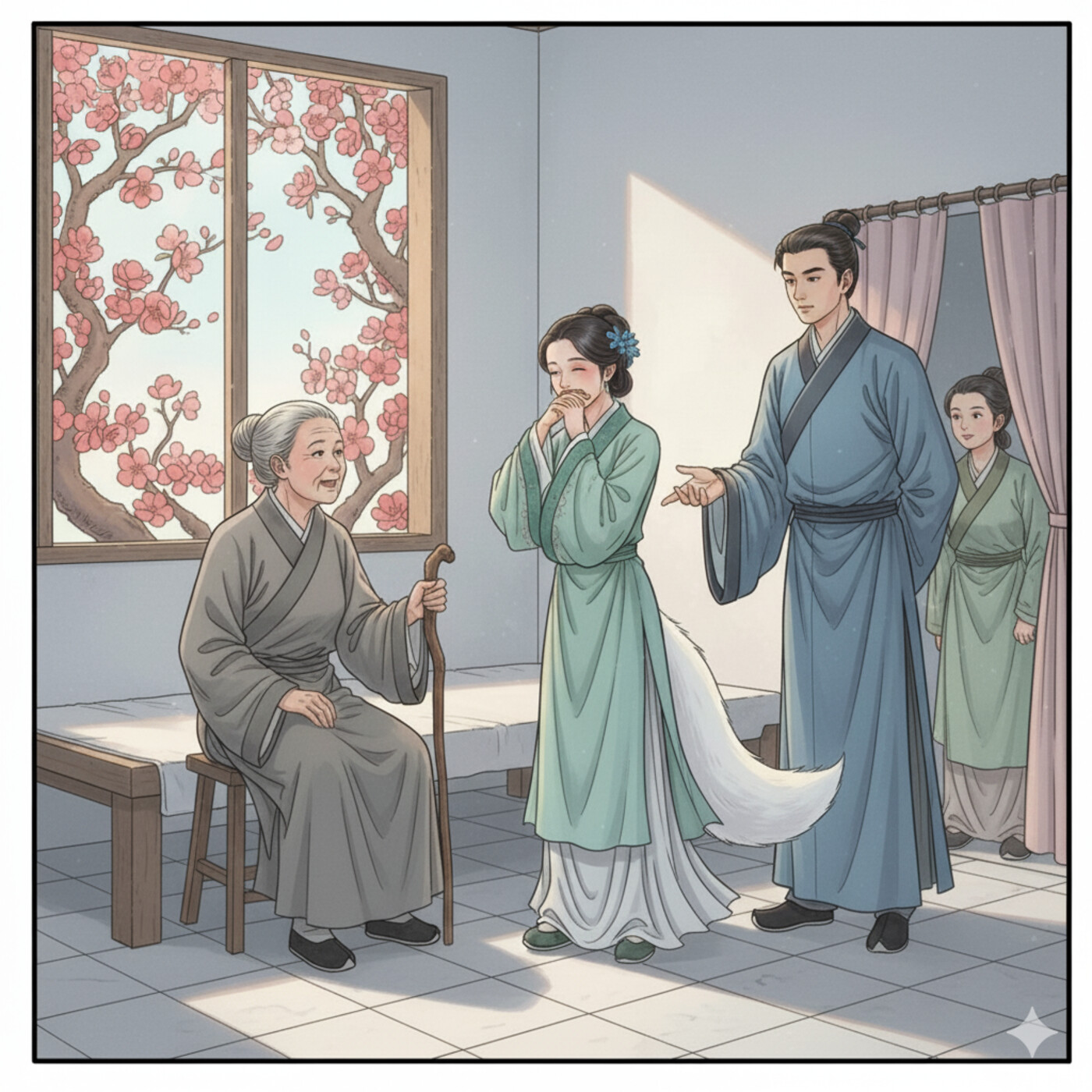
Meanwhile Wang’s mother, alarmed by her son’s disappearance, questioned cousin Wu. Remembering his fabrication, Wu dispatched servants toward the very hills he had named. They arrived just as Wang was considering his return. Joyfully he asked the aunt’s permission to bring Yingning home. “I have long wished for her to meet her aunt,” the old woman replied, instructing Yingning to pack and admonishing her to learn etiquette once she reached the prosperous Wang household.
Upon arrival, Mother Wang noticed the radiant girl and demanded to know her origins. Wang claimed she was his aunt’s daughter. His mother protested that Wu had lied earlier—she had no living sister. Yingning quietly explained that she had been raised by Mother Wang’s elder sister, who had married into the Qin family. When the mother examined the girl’s features and birthmarks, they matched her late sister exactly. She remained uneasy—how could the dead produce a living daughter?
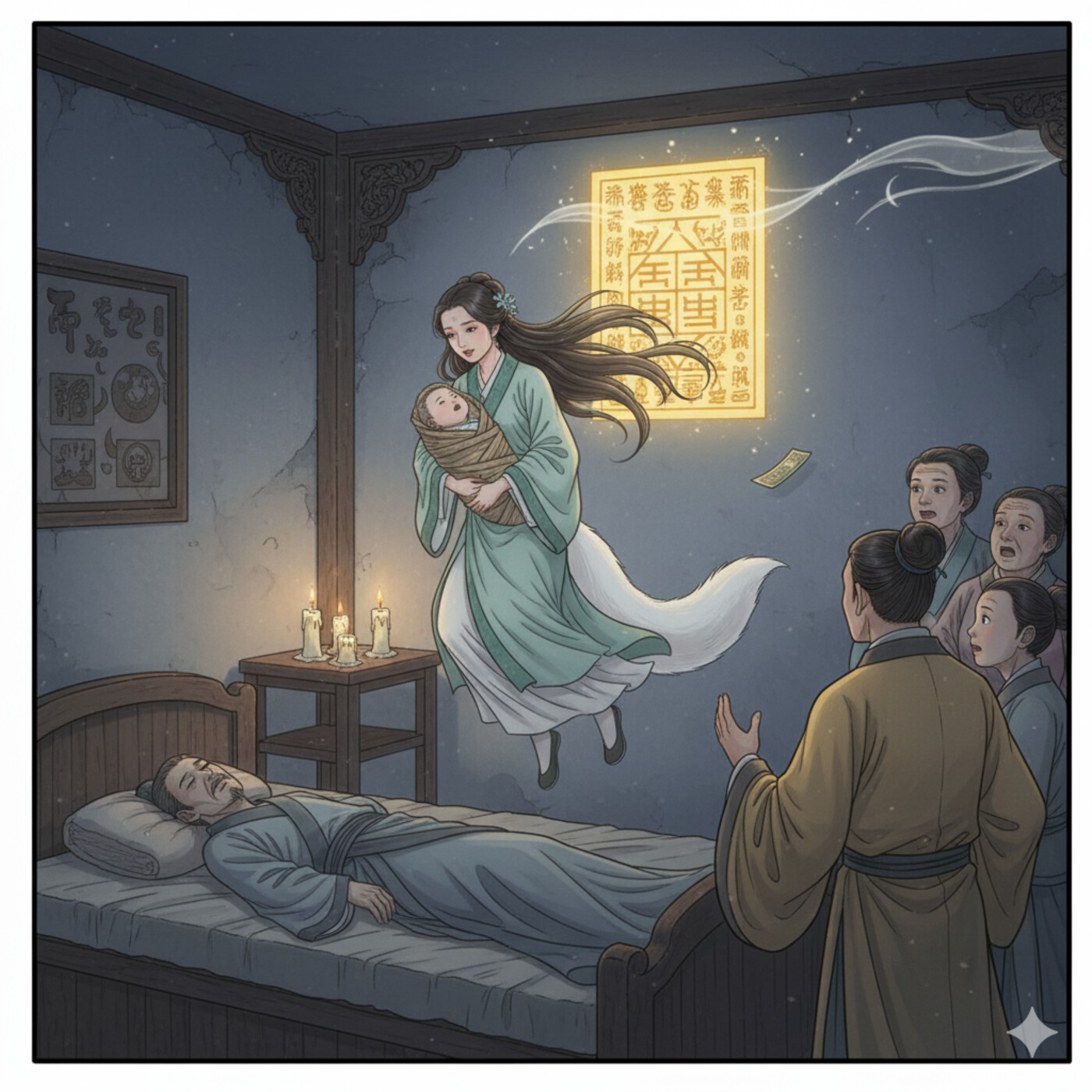
Wu soon arrived. Hearing the name “Yingning,” he recalled a tale: after his aunt died, his uncle lived alone and took in a fox spirit. A daughter named Yingning was born and left swaddled on the bed, visible to all. Even after the uncle’s death the fox returned until Daoist charms drove her away; she fled with the child. “Could this be that girl?” he marveled. From within the house Yingning’s laughter rang out unabashed.
Mother Wang ordered her to appear. Yingning managed a decorous bow before rushing back to the inner rooms, laughing aloud and drawing smiles from the womenfolk. The girl’s frankness and diligence soon endeared her to the household: she greeted her mother-in-law each dawn, excelled at needlework, and brightened every scolding with a grin.
Chapter V · Laughter and Suspicion
News of a fox-born bride stirred whispers. Wu returned to the mountain village to verify the tale but found only tumbled blossoms where the cottages had stood; even the graves lay hidden beneath weeds. Reporting this, he confirmed Mother Wang’s fears, yet Yingning showed no trace of dread. She moved in with the family’s younger daughter, laughing through chores and endearing herself to every servant.
Mother Wang arranged an auspicious day for the wedding rites, though she secretly inspected Yingning in sunlight to ensure she cast a human shadow. On the chosen day the girl laughed so hard she could not complete the formal bows, to everyone’s amusement. Despite her guileless demeanor she guarded the privacy of the bridal chamber, never hinting at intimate matters.
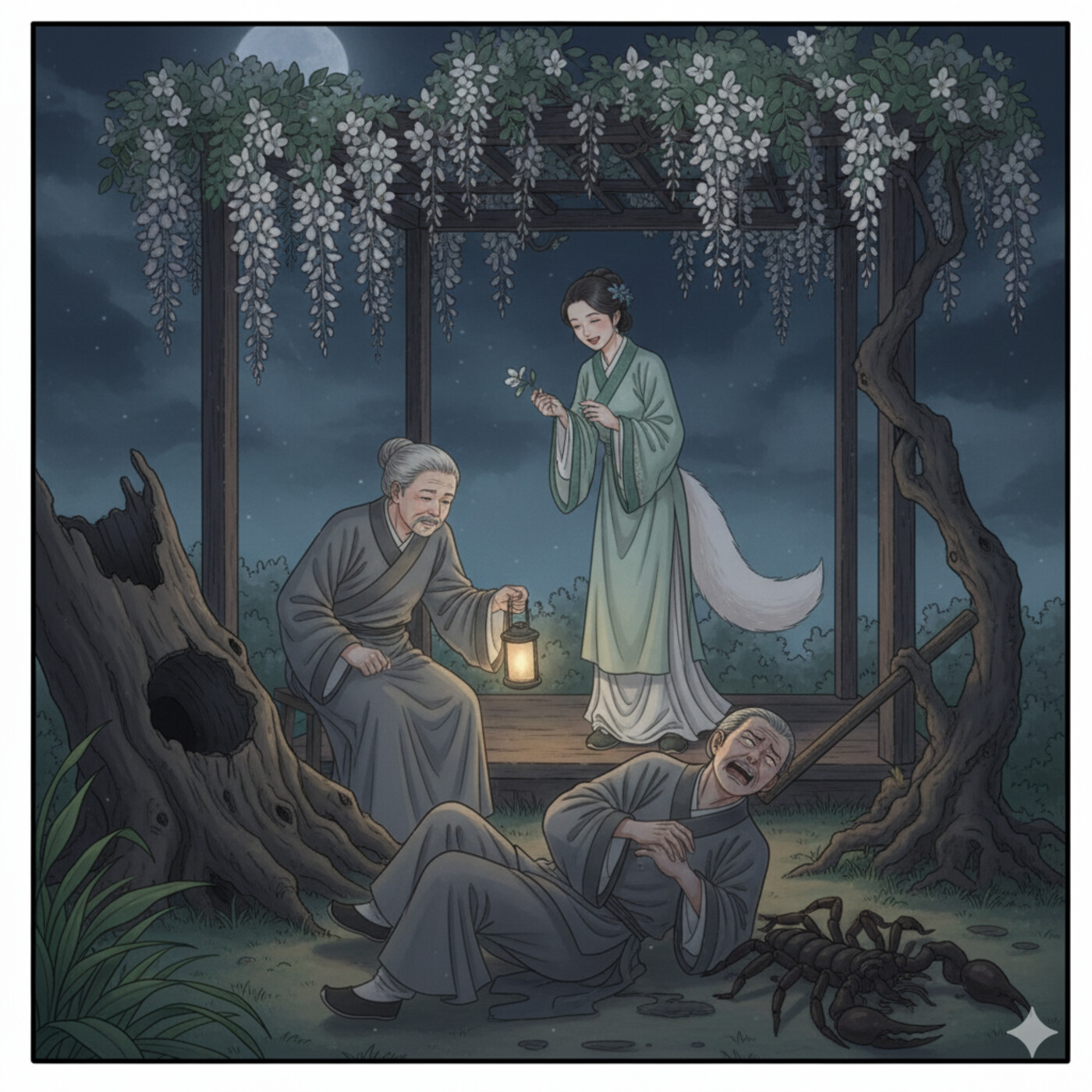
Yingning adored flowers. She pawned hairpins to purchase rare varieties and filled even the privy path with blooms. Behind the house stood a large wooden pergola of climbing roses abutting the western wall. She often climbed it, plucking blossoms to wear.
The neighbor’s son spied her there and mistook her smiles for invitation. When she pointed toward the wall base and slipped away laughing, he assumed it was a secret rendezvous. At dusk he crept to the spot, only to collapse in agony: the figure he embraced was a rotting log harboring a huge scorpion, which stung him mortally. His family accused Wang Zifu of harboring a sinister fox. The county magistrate, respecting Wang’s reputation, dismissed the charge as slander and released the neighbor after Wang interceded for leniency.
Mother Wang scolded Yingning, warning that boundless mirth could court disaster. The girl solemnly vowed never to laugh again. Astonishingly she kept her word, her face calm though not sorrowful, as if the wellspring of laughter had been sealed.
Chapter VI · Tears for the Fox Mother
One night, after days of unbroken composure, Yingning suddenly wept before Wang. “I feared to tell you too soon,” she sobbed, “lest you be frightened. I was born of a fox spirit. When my mother left, she entrusted me to a kindly ghost-woman who raised me for more than ten years. I have no brothers. Only you can help her now. She lies alone in the mountains; no one will move her grave or bury her beside those she loved. If you are not afraid of trouble or expense, rescue her, and perhaps mothers will hesitate before drowning or abandoning their daughters.”
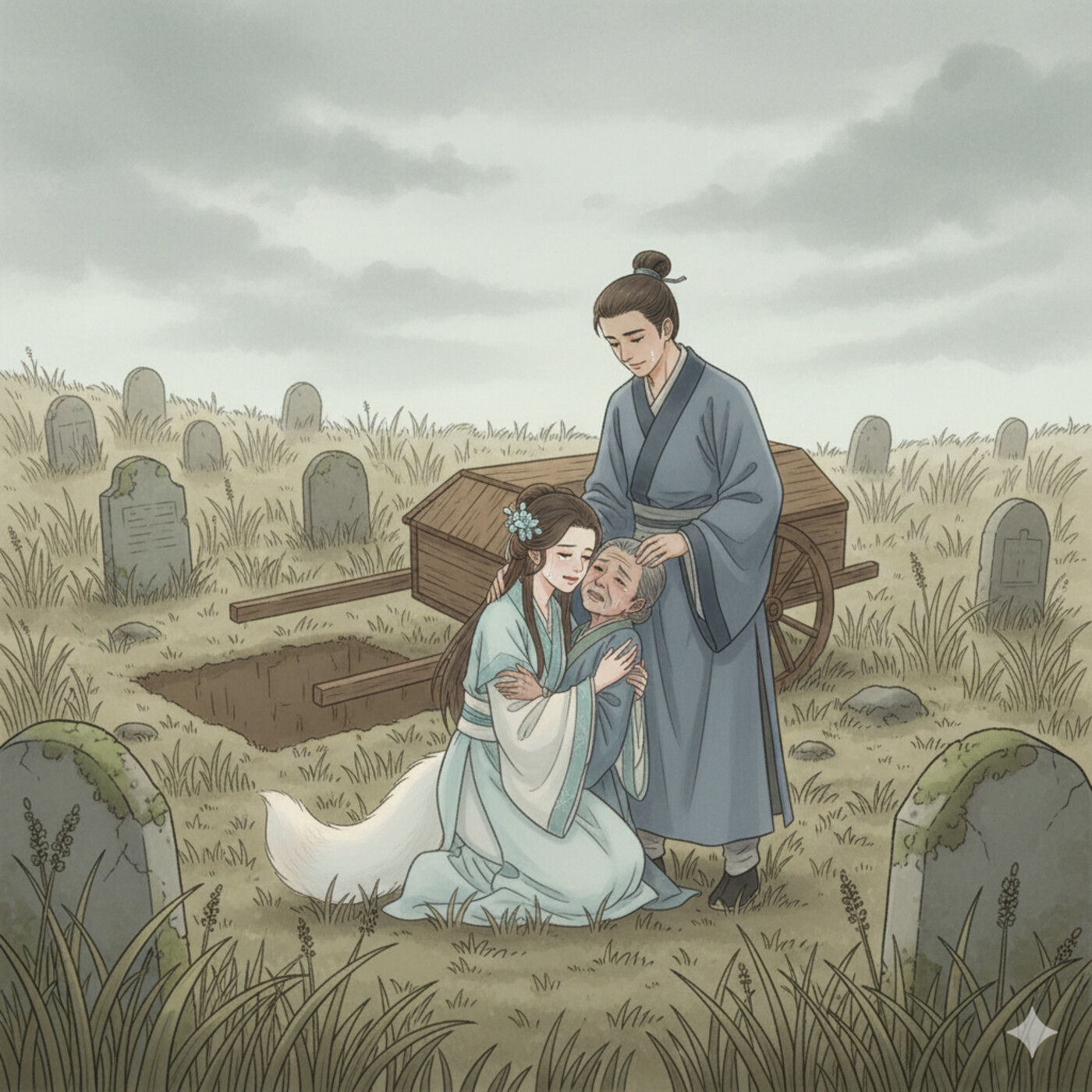
Wang agreed. On an appointed day the couple hired a cart and returned to the wilderness. Guided by Yingning’s sure sense, they found the old woman’s corpse perfectly preserved amid the wild grasses. Yingning clung to the body and wailed. They carried her remains home and interred her within the Qin ancestral graves, giving her the honor she deserved.
That night Wang dreamed of the old woman thanking him; Yingning revealed she too had seen the ghost, who asked her not to frighten Wang. When he inquired about the maid Xiaorong, Yingning said she was also a fox, clever and loyal, left behind to care for her. The spirit mother reported that Xiaorong had already married safely.
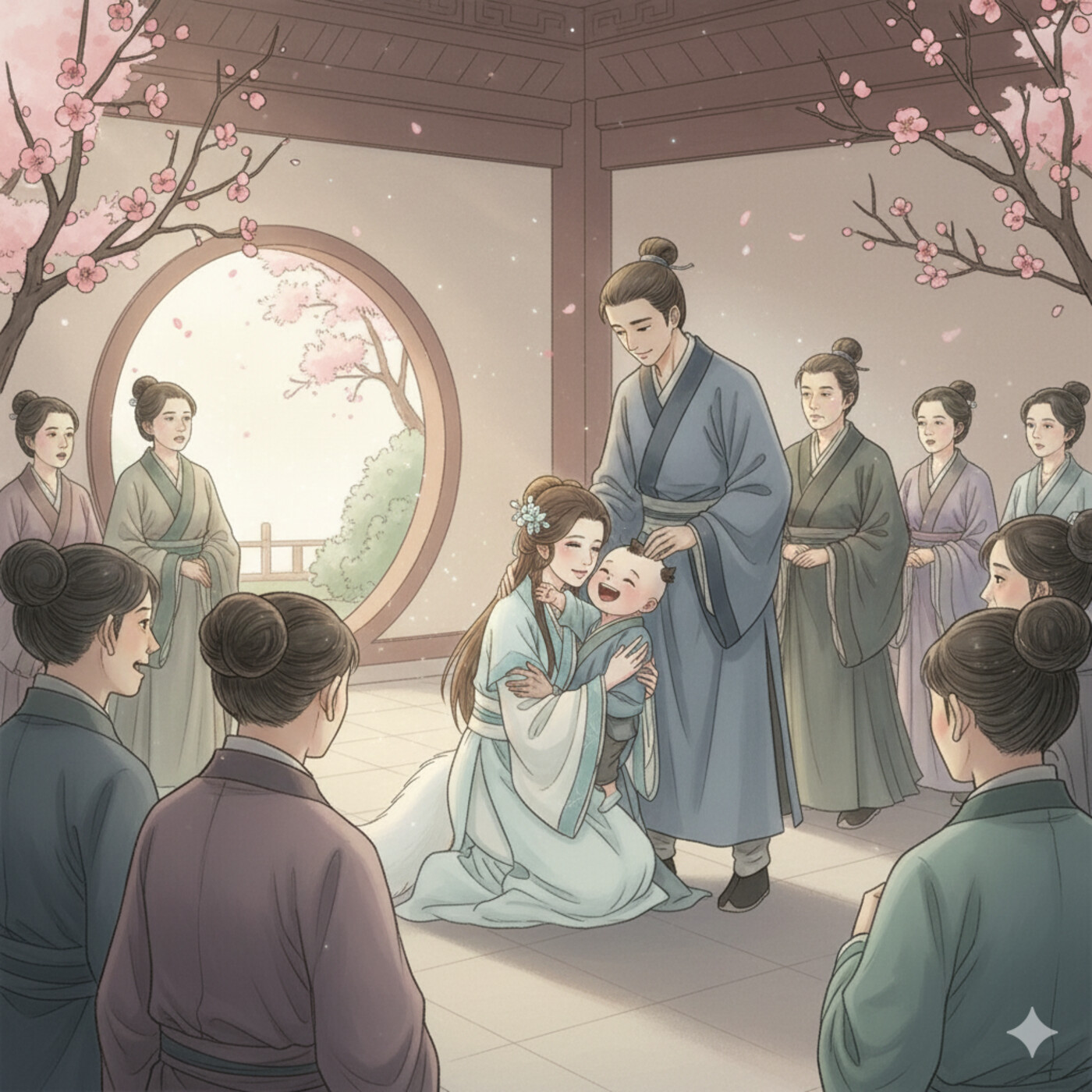
From then on, each Qingming the couple swept the Qin graves without fail. A year later Yingning bore a son whose ready laughter proved he had inherited his mother’s joyful nature.
Historian’s Note. “People think Yingning’s constant giggles mark a careless heart,” comments the collector, “yet her prank on the wall shows quick wit, and her mourning for the ghost-mother turns laughter into tears. Perhaps she used mirth as armor. I have heard of a mountain herb called ‘Laughing Bloom’: whoever smells it bursts into laughter. If one were to keep such a plant at home, even the pleasure herb and the forget-worry flower would pale. As for the so-called ‘talking flower,’ its simpering is truly tiresome.”