Chapter I · The Abandoned Estate
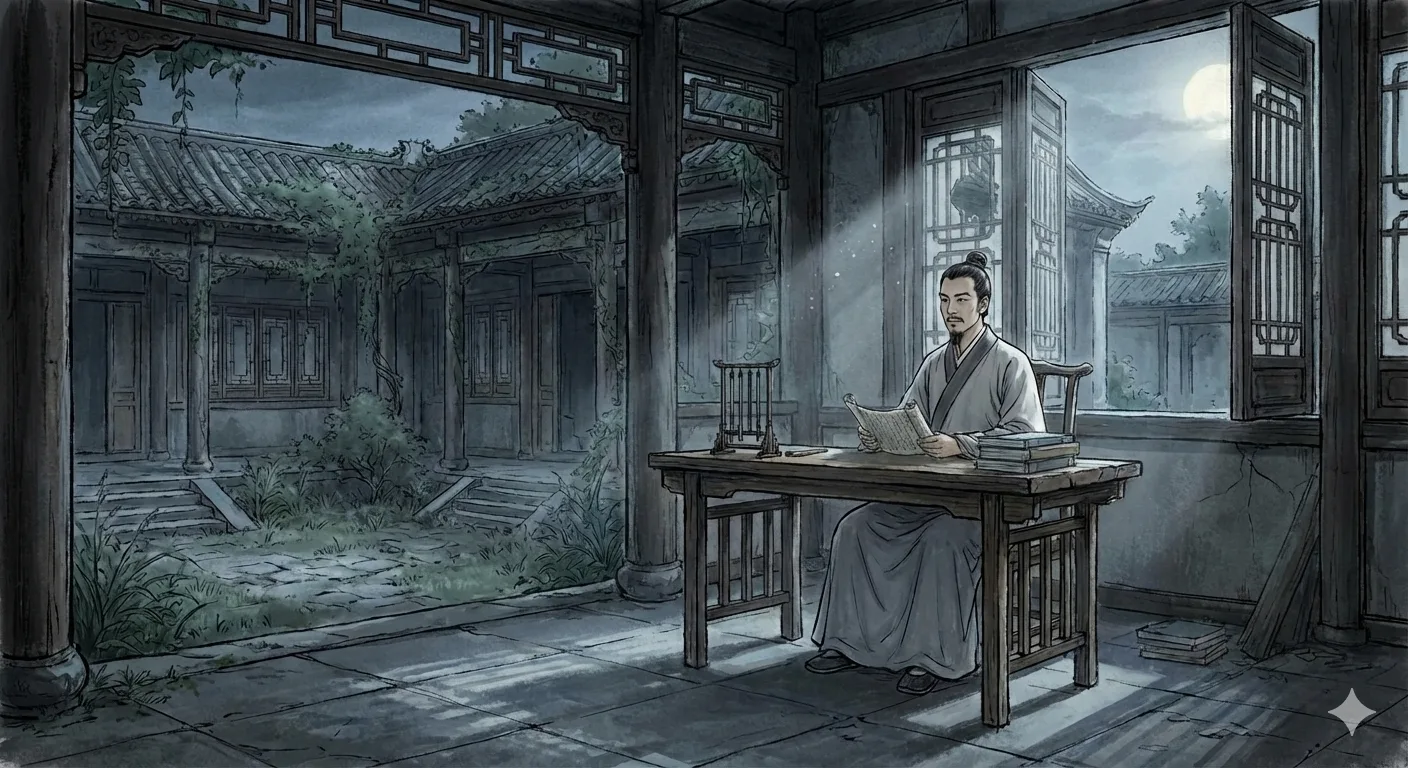
In Weinan, the residence of Commissioner Jiang was notorious for ghosts. He moved away, left a servant to guard the gate, and the servant died. Several replacements died as well, and the house was abandoned. A local scholar named Tao Wangsan was known for his dashing manner. He enjoyed hiring entertainers to drink with, yet once the banquet ended he always sent them away. Friends once sent a courtesan to him; he admitted her with a smile but never touched her. He once lodged at the Jiang house; when a maid tried to visit him at night, he refused, and Jiang respected him for it.
Tao was extremely poor and had lost his wife. His few thatched rooms were stifling in the humid summer, so he begged Jiang to let him borrow the abandoned estate. Jiang refused because of its deadly reputation. Tao wrote a "Continuation of the Treatise Against Ghosts" and said, "What can ghosts do to me?" Because he insisted, Jiang finally agreed.
Chapter II · The Pranks Begin
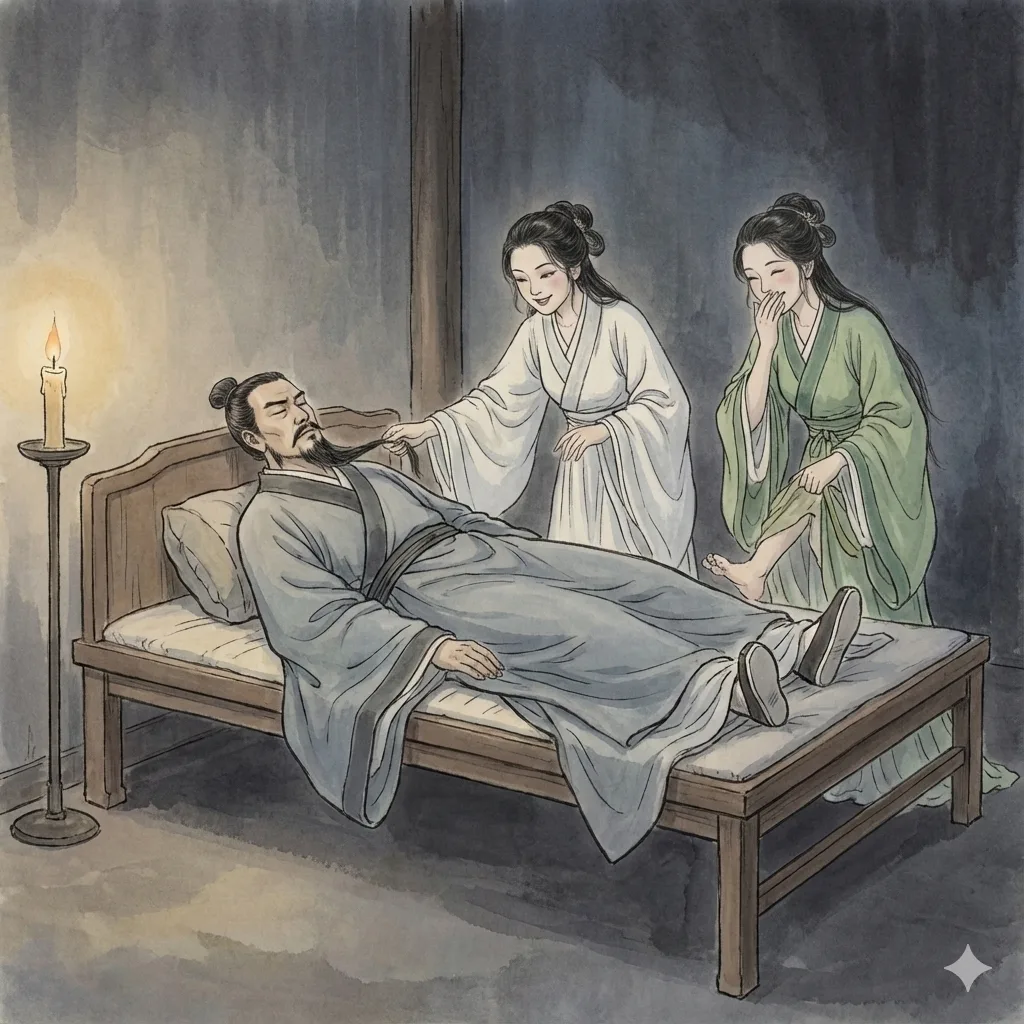
Tao went to clean the main hall. At dusk he left his books there, went out for other things, and returned to find them gone. He lay on the couch to wait. After a meal's time he heard footsteps and saw two girls emerge from a room, returning the books to the table. One looked about twenty, the other seventeen or eighteen. Both were lovely. They lingered at the bed, smiling at each other. Tao lay still. The older girl lifted a foot and kicked his belly; the younger covered her mouth, laughing. Tao felt his heart sway, but forced his thoughts straight and did not look at them. The older girl stroked his beard with one hand and tapped his cheeks with the other; the younger laughed even more. Tao suddenly sprang up and shouted, "How dare you ghost things!" They fled in alarm.
Fearing more torment at night, he wanted to move back, but was ashamed of his boast. He lit a lamp and read. In the dark, ghostly shadows moved, but he ignored them. Near midnight he slept. As soon as he closed his eyes, something thin pierced his nose; the itch made him sneeze, and he heard laughter in the dark. He pretended to sleep and waited. The younger girl crept up, twisting a strip of paper into a thin cord, moving like a crane and heron. Tao leapt up and scolded her; she darted away. When he lay down again, she poked his ears. He could not endure the harassment through the night. At cockcrow the sounds ceased; he finally slept deeply and saw nothing all day. As the sun sank, the girls reappeared. Tao cooked through the night to keep awake. The older girl leaned her arm on the desk to watch him read and covered his book; he tried to grab her and she scattered like mist. The younger girl covered his eyes with crossed hands and ran away laughing. He pointed and cursed, "Little ghosts! If I catch you, I will kill you both!" They were not afraid. Tao teased them: "I know nothing of bedroom arts. Clinging to me is useless." The girls smiled, turned to the stove, split firewood, washed rice, and cooked for him. When the porridge was done, they set out spoon, chopsticks, and bowl. Tao asked how he could repay them. They laughed, "We mixed arsenic and poison into your porridge." He said, "We have no old grudge - why do this?" He drank; they refilled the bowl and ran about serving him. Tao delighted in them and soon grew used to their company.
Chapter III · The Ghost School
As the days passed, they grew familiar. Tao sat with them and learned their names. The older said, "I am Qiu Rong of the Qiao family; she is Xiao Xie of the Ruan family." When he asked their origin, Xiao Xie laughed, "Foolish scholar, we have not dared show ourselves, and you already ask about our lineage - do you wish to marry us?" Tao replied solemnly, "How could I face such beauty and feel nothing? Yet the chill of the underworld kills men. If you do not wish to live with me, you may go; if you do, stay at ease. If you do not love me, why stain two fine women? If you do love me, why kill a mad scholar?" The two girls looked at each other and were moved. From then on they no longer tormented him so much, though they still slipped hands into his robe or tugged at his trousers, which he took as harmless.
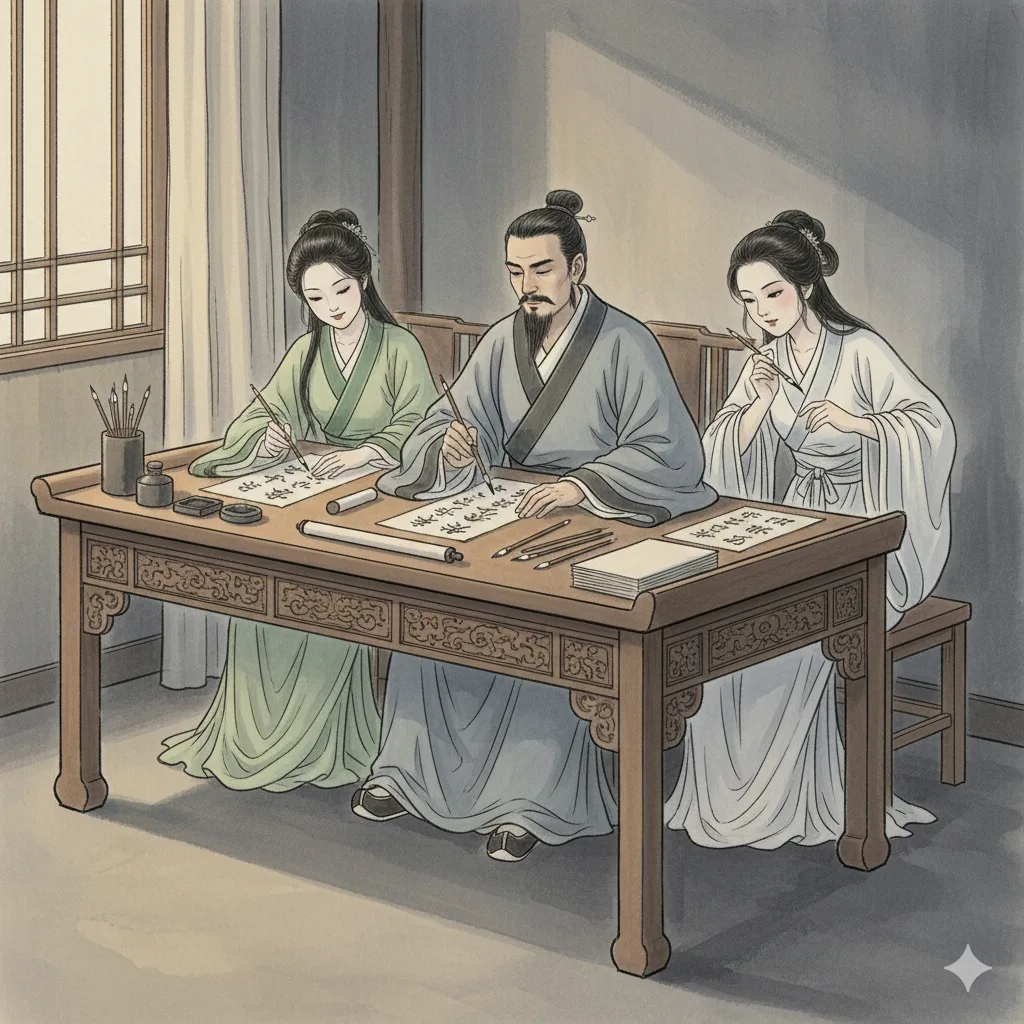
One day Tao went out before finishing a copy. When he returned, Xiao Xie was bent over the desk, holding the brush and copying for him. She tossed the brush and smiled askance. Her characters were rough but in orderly lines. "You are an elegant soul," he said. "If you enjoy this, I will teach you." He drew her into his arms and guided her wrist. Qiu Rong returned and her face changed with jealousy. Xiao Xie said, "I once learned calligraphy from my father, but long neglect made it dreamlike." Qiu Rong stayed silent. Tao understood and pretended not to notice, handed her the brush, and said, "Let me see if you can do this." She wrote a few characters; he praised, "Qiu-niang, such fine strokes!" She brightened. He folded two sheets as models for them to copy. He read by another lamp, pleased they were occupied and no longer disturbed him. When they finished, they stood respectfully for his judgment. Qiu Rong could not read, and her scrawl was hardly legible. She saw herself fall short of Xiao Xie and felt ashamed, but Tao comforted her until her face cleared.
From then on the two studied under him. When he sat they scratched his back; when he lay they massaged his legs. They no longer dared to insult him and instead sought to please him. Within a month Xiao Xie's writing became neat. When Tao praised her, Qiu Rong was so ashamed that her powder and brow ink ran with tears. Tao soothed her in every way. He then taught them to read; they were sharp and needed no second instruction. They competed in reading late into the night. Xiao Xie brought her younger brother Sanlang to study as well. He was fifteen or sixteen, handsome, and presented a golden ruyi hook as a gift. Tao assigned him and Qiu Rong one classic; their chanting filled the hall. It became a ghost school. When Jiang learned of it, he was pleased and sent firewood and rice on schedule. After a few months, Qiu Rong and Sanlang could both write poems and trade verses. Xiao Xie secretly asked Tao not to teach Qiu Rong; Qiu Rong secretly asked him not to teach Xiao Xie; he agreed to both. One day Tao left to sit for the examinations. The two girls wept as he departed. Sanlang warned, "You can feign illness and avoid the test. If not, I fear misfortune." Tao considered such an excuse shameful and went anyway.
Chapter IV · Injustice and Rescue
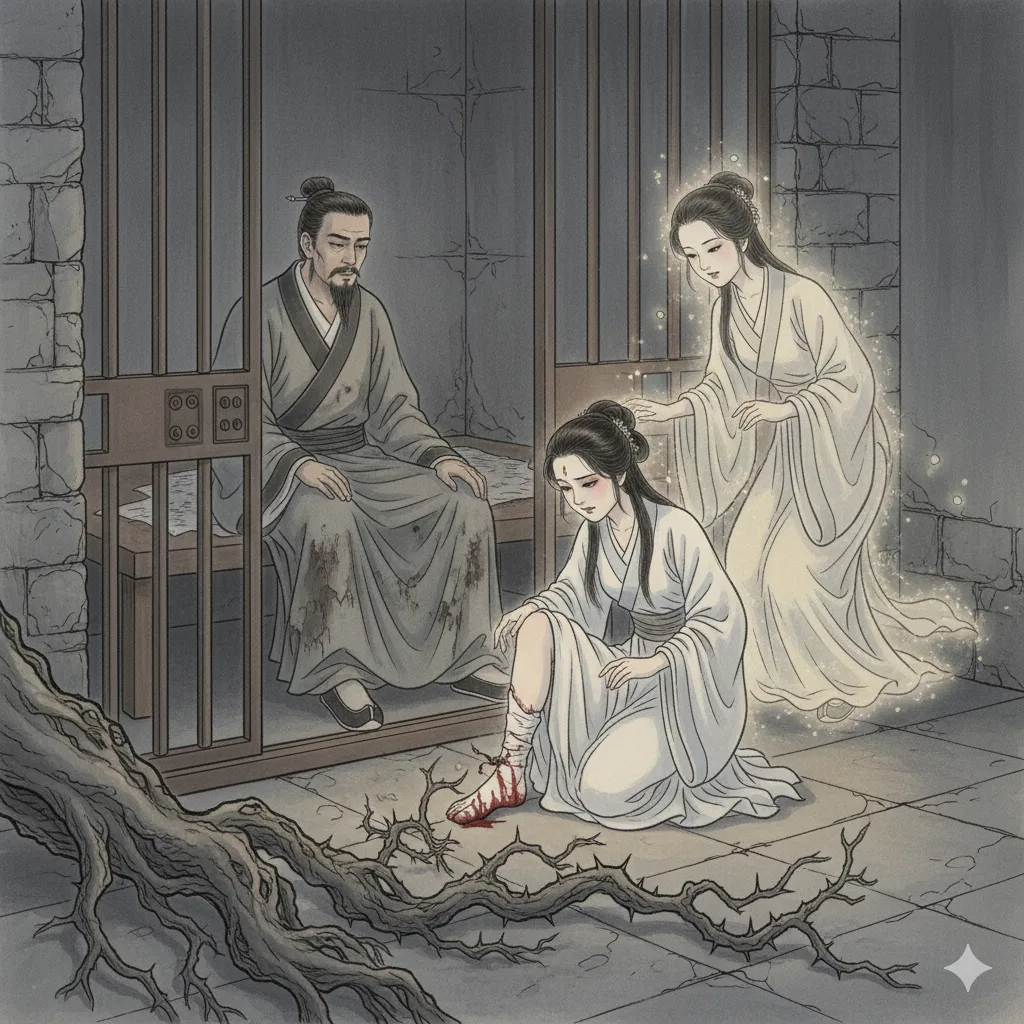
Tao had mocked current affairs in his poetry and offended a powerful local elite, who sought revenge. He bribed the education commissioner, slandered Tao's conduct, and had him thrown into prison. With no money, Tao begged food from other inmates and believed he would die there. Suddenly Qiu Rong drifted in with food. She wept with him and said, "Sanlang feared your journey would go ill. He came with me to petition the governor." She vanished before anyone could see her. The next day, when the governor rode out, Sanlang blocked the road to cry injustice and was seized. Qiu Rong returned to tell Tao, then went out to inquire and did not return for three days. Tao wasted away in hunger and fear. Xiao Xie arrived, desolate: "Qiu Rong passed the City God temple and was seized by the black judge of the western corridor, who forced her to become his concubine. She refused and is imprisoned. I ran a hundred li to reach you; at the north gate, old thornbushes pierced my soles. The pain strikes bone; I may not return again." She showed her feet, blood staining her shoes, left three taels of silver, and limped away.
The governor interrogated Sanlang. Seeing he had no true connection to Tao and was only crying for him, he ordered him beaten. Sanlang collapsed and vanished. The governor was astonished. He read the petition and was moved by its sorrow. He summoned Tao and asked, "Who is Sanlang?" Tao pretended not to know. The governor realized the case was false and released him. That night Xiao Xie arrived and said, "Sanlang was dragged to the underworld by the yamen god. Because of his righteousness, Yama sent him to be reborn in a wealthy family. Qiu Rong is still captive. I tried to submit a petition to the City God but it was blocked. What can we do?" Tao raged, "That black old demon dares such things! Tomorrow I will smash his statue and drag the City God before me. Are his clerks so cruel while he sleeps drunk?" Their grief and anger kept them awake until dawn.
Suddenly Qiu Rong returned, and they rejoiced. She wept, "I have suffered for you! The judge threatened me daily with knives and cudgels. Tonight he released me and said: 'I had no other intent. I only loved you. Since you would not consent, I never defiled you. Please tell Tao Qiucao not to blame me.'" Tao felt a little relieved and wanted to sleep with them, saying, "Tonight I would die for you." The girls replied sadly, "Your teaching showed us right and wrong. How can we kill the one we love?" They refused, yet leaned their heads to him like true spouses. After their trials, all jealousy between them was gone.
Chapter V · Rebirth and Merging
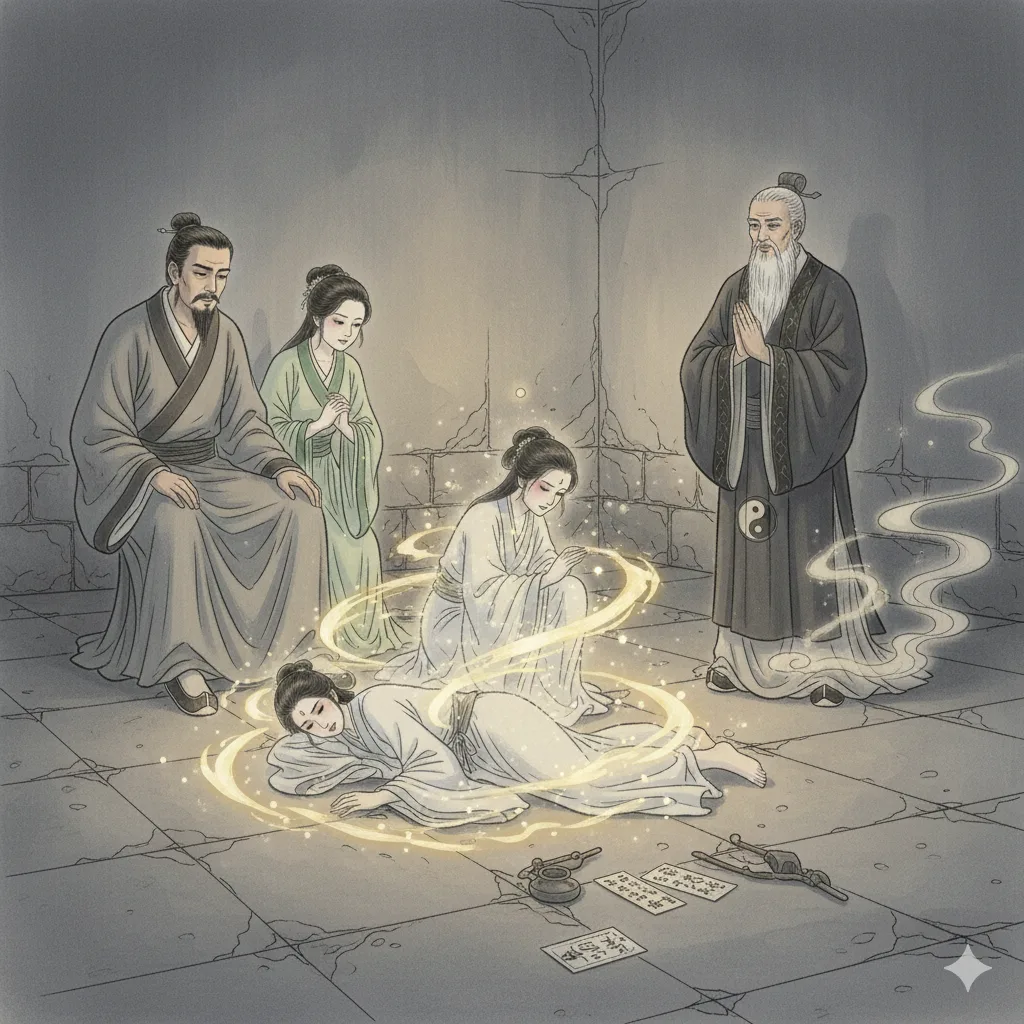
A Taoist met Tao on the road and said he carried ghostly qi. Tao told him everything. The Taoist replied, "These two ghosts are good; do not betray them." He wrote two talismans and said, "Give them to the girls. When you hear a daughter crying outside, they must swallow the talismans and rush out. Whoever arrives first will live again." Tao thanked him and told the girls. A month later they heard a family wailing. The girls ran; Xiao Xie was in such haste that she forgot to swallow her talisman. A funeral procession passed. Qiu Rong ran into the coffin and vanished. Xiao Xie could not enter and returned in tears. Tao went out and saw the Hao family burying their daughter. People saw a girl enter the coffin and were astonished. Soon they heard a sound within, set it down, and found the girl alive. They kept her at Tao's courtyard. When she opened her eyes she asked for Tao. The Hao family questioned her, and she said, "I am not your daughter." She told them the truth. They tried to carry her home, but she refused and ran into Tao's room, lying down. The Hao family then accepted Tao as son-in-law. Tao saw her face - different, yet as radiant as Qiu Rong's. He was delighted beyond hope.
Suddenly a ghostly sobbing came from a dark corner: Xiao Xie was weeping. Tao went with a candle to soothe her, but her sleeves were soaked and her grief could not be eased. At dawn she left. The Hao family sent a maid and an old woman with bridal gifts, and Tao became their son-in-law. Yet each night Xiao Xie returned in tears. For six or seven nights the couple was too sorrowful to complete their marriage.
Tao had no solution. Qiu Rong said, "The Taoist is an immortal; go and beg again." Tao found him, knelt, and told his plight. The Taoist insisted he had no art, but Tao pleaded. The Taoist laughed, "Foolish scholar, you cling too hard. Since fate is in it, I will exhaust my art." He came, requested a quiet room, shut the door, and said no one should disturb him. For more than ten days he ate and drank nothing. When Tao peered inside, he looked like a sleeping corpse. One morning a young girl entered with bright eyes and white teeth, her beauty shining. She smiled, "I ran all night and am exhausted. You would not stop pestering me, so I went a hundred li away and found a fine body. The Taoist carried her back. Once I meet her, I will hand her over." At dusk Xiao Xie arrived; the girl rose to embrace her, and the two merged into one, collapsing stiff and still. The Taoist emerged, bowed, and departed. Tao thanked him and returned; the girl had awakened. He helped her to the bed. Her breath smoothed, her limbs softened, though she clutched her feet, groaning that her toes and thighs ached. After a few days she could rise.
Chapter VI · Recognition and Chronicle
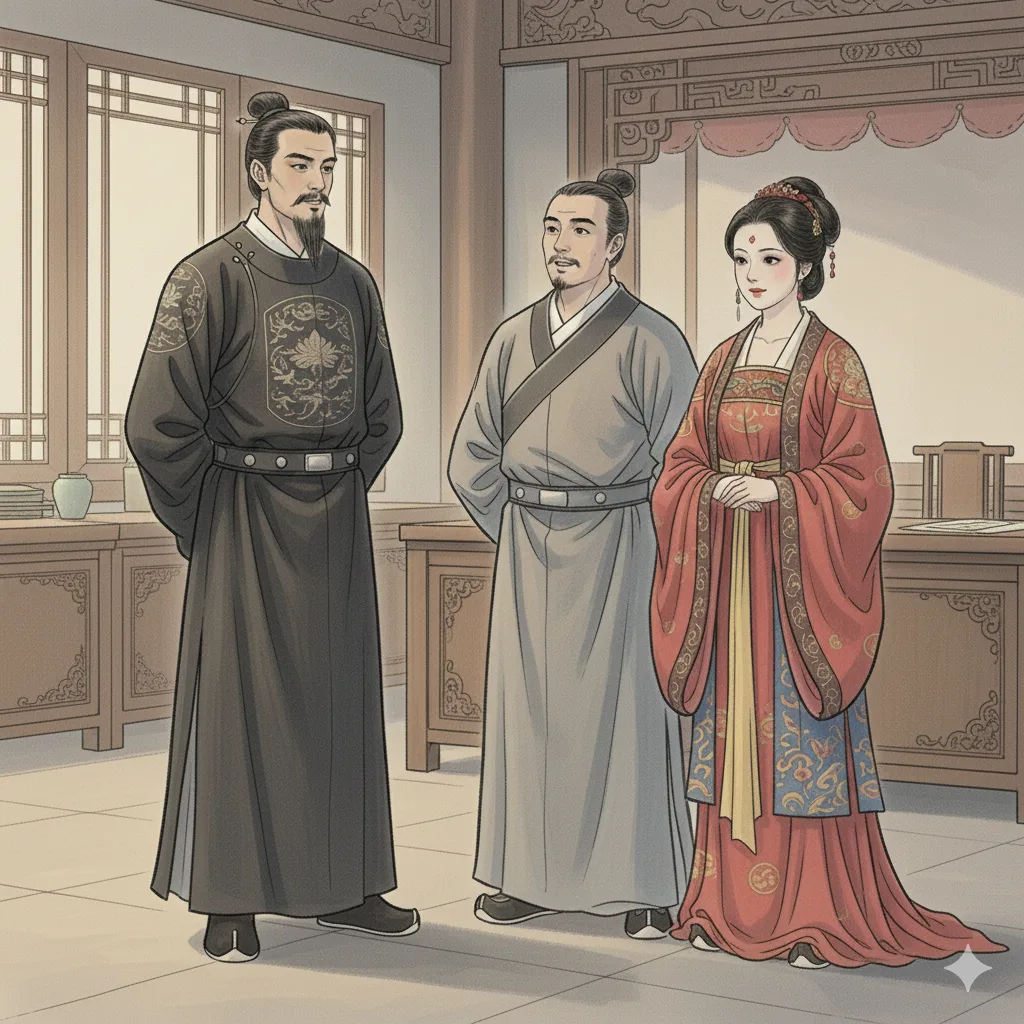
Later Tao passed the examinations and entered office. A man named Cai Zijing, from the same examination cohort, visited and stayed for days. Xiao Xie returned from a neighbor's home; Cai saw her and hurried after her. She turned aside, annoyed at his forwardness. Cai told Tao, "There is a matter that shocks everyone. May I tell you?" He said that three years earlier his younger sister died, and two nights later her body vanished; he had never resolved the doubt. "Your wife looks exactly like her," he said. Tao replied, "My wife is plain - how could she compare to your sister? But since we are classmates, let me present my wife." He asked Xiao Xie to wear the burial clothes and come out. Cai was stunned: "It is truly my sister!" He wept. Tao told him the entire story. Cai rejoiced, "My sister lives; I must return to comfort our parents." He left, and after some days the whole family came. Thereafter they visited one another as closely as the Hao family.
The chronicler says: a peerless beauty is hard to find even once; how could one man obtain two? Such a thing happens only once in a thousand years, and only to a man who would not run away with a private woman. Is the Taoist an immortal? How miraculous his art. If such skills exist, even ugly ghosts would be worth befriending.